


How to Pause a Subscription in Recharge and Three Experiments to Test if It Improves Customer Retention


A subscription pause can retain customers whose reason for leaving is temporary, but only if you offer it selectively and measure whether it creates incremental retained value.
Who this guide is for
This guide is for product, growth, retention, ecommerce, and engineering teams at subscription businesses using Recharge that want greater control over how pause offers are targeted, executed, and measured.
It is especially useful for teams with enough cancellation volume to run controlled experiments and enough customer context to move beyond blanket offers and pause-acceptance reporting.
Who this guide isn't for
This is not a beginner's guide to Recharge or a general introduction to subscription management.
If you only need the endpoint mechanics, Recharge's custom customer portal API guide maps subscription-management actions to the relevant API requests.
This guide addresses the strategic layer: how to implement a pause as a targeted intervention, determine who should receive it, and measure whether it actually works.
Target pauses based on cancellation intent
Don't show a pause to every subscriber who clicks cancel.
A pause may make sense when the reason for leaving is temporary:
A short-term budget constraint.
Seasonal usage.
Not needing the product until a specific future date.
Too much product.
Compare that with someone leaving because of a competitor, poor product fit, or a persistent price objection.
A pause doesn't solve those problems. It just moves the cancellation decision into the future.
How to set up a pause in Recharge
There are two options to setup a pause in Recharge depending on your offer to the customer.
Option 1: Move the next charge date
Recharge documents the following endpoint for changing a subscription's charge date:
POST https://api.rechargeapps.com/subscriptions/{subscription-id}/set_next_charge_date
For example:
curl --request POST \
  --url https://api.rechargeapps.com/subscriptions/{subscription-id}/set_next_charge_date \
  --header 'Content-Type: application/json' \
  --header 'X-Recharge-Access-Token: {api-token}' \
  --header 'X-Recharge-Version: 2021-11' \
  --data '{"date":"2026-11-01"}'
Use this when the promise is a specific return date. Store the original schedule and the selected pause duration in your retention system so you can analyze what happened afterward.
Option 2: Skip a queued charge
If the promise is “skip my next order,” use the queued charge rather than treating the subscription as indefinitely paused:
POST https://api.rechargeapps.com/charges/{charge-id}/skip
For example:
curl --request POST \ --url https://api.rechargeapps.com/charges/{charge-id}/skip \ --header 'Content-Type: application/json' \ --header 'X-Recharge-Access-Token: {api-token}' \ --header 'X-Recharge-Version: 2021-11' \ --data '{"purchase_item_ids":[123456789]}'
A skip is narrower than a pause. It is often the better intervention when the subscriber has too much product but still expects to continue on the following order.
Don't forget to pause fulfillment
Recharge coordinates recurring charges with physical orders. That means the retention experience must account for both billing and fulfillment.
Before moving a date or skipping a charge, determine:
Whether the upcoming charge has already entered processing.
Whether an order has already been created in the ecommerce platform.
Whether a fulfillment request has already been sent.
Whether one-time products are attached to the upcoming order.
Whether multiple subscriptions share the same queued charge.
A customer can reasonably interpret “pause” to mean that neither billing nor shipment will occur. Your implementation needs to enforce both sides of that promise.
Testing a pause
Once the Recharge implementation is working, the next question is whether the pause improves the outcome.
The platform can move the charge date or skip an order. It cannot tell you whether the intervention retained more value than the alternative.
You might assume:
Three months is the ideal pause duration.
“Too expensive” customers should receive pauses.
A pause is better than a discount.
A subscriber who accepts a pause has been saved.
Each is a hypothesis.
The question is:
Did offering the pause outperform the alternative for this type of subscriber?
There are three experiments worth running.
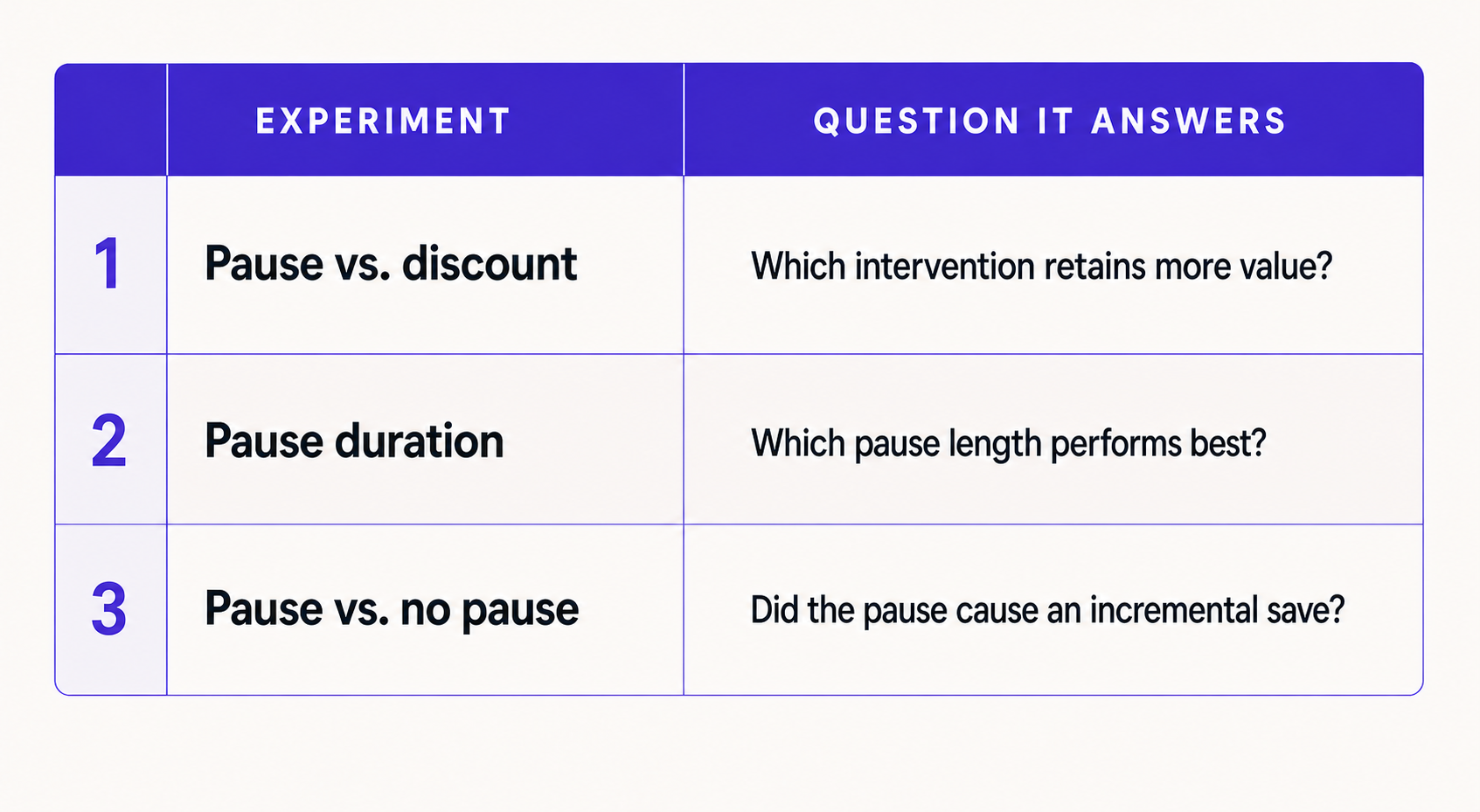
Experiment 1: Pause vs. discount
For cancellation reasons where either intervention makes sense, split eligible subscribers between a pause and a discount.
A two-month pause gives up all subscription revenue during the delay. A 20% discount reduces revenue on the discounted orders but may preserve the delivery cadence.
Compare incremental retained value, including revenue forgone during the intervention, resumed order value, subsequent skips, and post-intervention survival.
Experiment 2: Pause duration
Test the length and number of pause options—for example, one, two, or three order intervals.
Longer options may increase acceptance but reduce the probability of another successful order. Shorter pauses may have lower acceptance while returning customers to the buying cycle sooner.
The option with the highest acceptance rate is not necessarily the one that creates the most retained value.
Experiment 3: Pause vs. no pause
Create a control group by randomly withholding the pause from a percentage of subscribers who would otherwise qualify for it.
Then compare retained value between the treatment and control groups over time.
Some subscribers who accept a pause might have decided not to cancel anyway. Others will cancel when the delayed order approaches.
Both can look like successful saves on the day the pause is accepted. Only the control-group comparison tells you what the intervention actually changed.
Don't optimize for pause acceptance
Pause acceptance is easy to measure.
It's also incomplete.
Suppose you offer a three-month pause to 1,000 subscribers and 400 accept it.
You could report:
40% pause acceptance rate.
But you still don't know:
How many would have stayed without the offer.
How many resume after three months.
How long resumed subscribers remain.
How much revenue you gave up during the pause.
Whether a different intervention would have performed better.
Measure successful post-pause orders, time to next charge, repeat skips, post-return retention, deferred revenue, incremental retained value, and performance against a control group.
Your resume strategy is part of the pause
Don't treat the scheduled resume date as the end of the intervention.
A subscriber surprised by a charge after three months away may immediately cancel again.
Create a deliberate resume sequence.
Before billing resumes, tell the subscriber:
When their subscription will resume.
How much they'll be charged.
What plan they're returning to.
How to manage their subscription.
What's changed or improved while they've been away, when relevant.
Then measure what happens.
Did they resume successfully?
Did payment fail?
Did they immediately cancel?
Did they remain subscribed for another 30, 90, or 180 days?
The quality of the resume matters as much as the acceptance of the pause.


Turn pause behavior into churn intelligence
Every pause gives you more than a retention outcome.
It gives you evidence.
Suppose customers selecting “not using it” accept pauses at a high rate but rarely resume.
The cancellation survey told you one thing:
They're not using the product right now.
Their subsequent behavior tells you something more useful:
Temporary non-use may actually be a persistent engagement problem.
That insight should inform activation, onboarding, and product strategy.
Or suppose customers selecting “too expensive” resume at unusually high rates after a pause.
Maybe price wasn't the underlying issue.
Timing was.
And consider a subscriber who pauses but never returns.
They're one of your highest-context winback opportunities.
You know:
Why they originally wanted to leave.
That they intended to return.
Which intervention they accepted.
When they expected to return.
When that intent finally expired.
That's substantially more context than you have for an ordinary churned subscriber.
The intervention doesn't just retain or lose the customer.
It creates evidence that can improve the next retention decision.
Your cancellation flow shouldn't be a closed system.
What you learn there should improve onboarding, pricing, product decisions, winback, and the rest of the customer lifecycle.

From offering pauses to practicing retention
The goal isn't to build the perfect pause flow. It's to build confidence in when a pause works, for whom, and why.
That means moving from:
“We offer a three-month pause because we think it helps.”
to:
“We know which customers benefit from a pause, which duration performs best, how it compares with other interventions, and how much incremental value it retains.”
Recharge gives you the infrastructure to execute the subscription change.
But it can't:
Determine why a subscriber is leaving.
Combine that intent with customer context.
Decide which intervention to show.
Run controlled experiments across those interventions.
Measure retained value by segment.
Feed those results into the next iteration.
ProsperStack provides sophisticated subscription businesses with a measurable system for improving retention, starting at cancellation.
It helps teams determine when a pause is worth offering, who should receive it, and whether it created incremental retained value.


